
Introduction
Oil prices have once again become a major concern for global economies and financial markets in 2026. Rising crude oil prices are increasing transportation, manufacturing, and energy costs worldwide, putting renewed pressure on inflation. Investors, policymakers, and consumers are increasingly worried that persistently high energy prices could slow economic growth while keeping inflation elevated. The current situation has drawn strong historical comparisons to the oil shocks of the 1970s and early 1980s, when geopolitical tensions and supply disruptions caused energy prices to surge dramatically. Understanding the causes of today’s oil rally, and its historical parallels, helps explain why energy prices remain one of the most important drivers of the global economy.
Why oil prices are rising in 2026
Middle East instability
- Rising geopolitical tensions in the Middle East have increased fears of oil supply disruptions.
- Concerns over shipping routes, particularly around the Strait of Hormuz and Red Sea trade routes, have added uncertainty to global energy markets.
- Any threat to oil infrastructure or transport routes tends to push oil prices higher due to fears of reduced global supply.
Russia and global energy markets
- Ongoing geopolitical tensions involving Russia continue to impact global crude oil and natural gas supplies.
- Western sanctions and export restrictions have altered global energy trade flows.
- Energy markets remain highly sensitive to any disruptions involving one of the world’s largest oil exporters.
Supply discipline by major producers
- OPEC+ countries, led by OPEC and Russia, have continued maintaining controlled oil production levels.
- Production cuts were initially introduced to stabilise prices but have also tightened global supply.
- Lower supply combined with stable or rising demand has naturally pushed oil prices higher.
Strong global energy demand
- Despite slower global growth in some regions, energy demand remains resilient.
- Emerging economies, particularly in Asia, continue to consume large amounts of oil for:
- Manufacturing
- Transportation
- Infrastructure development
- Aviation and logistics
Reduced long-term investment
- Over the past decade, energy companies reduced investment in large-scale oil exploration projects.
- ESG pressures and the global energy transition encouraged many firms to focus more on renewable energy.
- As a result, spare production capacity remains relatively limited.
Weakness in major currencies
- Oil is globally priced in US dollars.
- Currency fluctuations can increase oil import costs for many countries.
- Weaker local currencies amplify inflationary pressures caused by rising energy prices.
Historical comparison: The 1973 Oil Shock
What happened?
- In 1973, Arab oil-producing nations imposed an oil embargo following the Arab-Israel war.
- Oil exports to several Western countries were restricted.
- Global oil prices surged dramatically within months.
Economic impact
- Energy shortages emerged across many developed economies.
- Petrol rationing and fuel queues became common in several countries.
- Businesses faced rapidly rising production and transportation costs.
Oil and inflation connection
- Oil is a critical input across nearly every sector of the economy.
- When oil prices rise sharply:
- Transportation becomes more expensive
- Manufacturing costs increase
- Food prices rise
- Heating and electricity costs climb
Inflation explosion
- During the 1970s, many Western economies experienced double-digit inflation.
- The combination of rising prices and slowing economic growth became known as “stagflation.”
Why stagflation was so dangerous
- Traditional economic policies struggled to address both inflation and weak growth simultaneously.
- Higher interest rates slowed economies further.
- Rising unemployment added additional economic pressure.
Aggressive Central Bank response
- Central banks, particularly the Federal Reserve, sharply increased interest rates to control inflation.
- Interest rates in the United States reached exceptionally high levels.
Economic recession
- Tight monetary policy eventually reduced inflation.
- However, it also triggered severe recessions in several economies.
- Borrowing costs surged for businesses and households.
The graph below demonstrates the connection between oil prices and inflation.
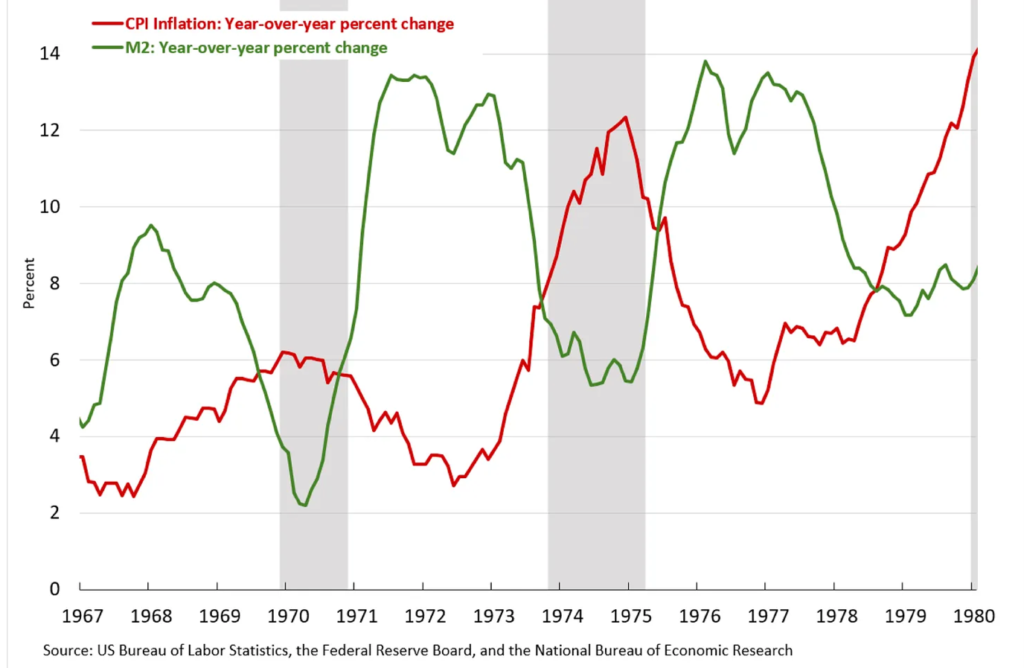
Source: Meanwhile in Markets
Similarities between 2026 and the 1970s
Geopolitical uncertainty
- Both periods were heavily influenced by geopolitical instability affecting oil supply.
- Energy security concerns remain central to global economic policy.
Inflationary pressure
- Rising oil prices are once again feeding into broader inflation across goods and services.
- Consumers are experiencing higher transport, utility, and food costs.
Supply Constraints
- Like 1970s, supply disruptions and production limitations are contributing to higher prices.
Key differences between 2026 and the 1970s
More diversified energy sources
- Economies today are less dependent on oil than they were in the 1970s.
- Renewable energy, nuclear power, and natural gas play larger roles in global energy supply.
Improved Central Bank credibility
- Modern central banks have stronger inflation-targeting frameworks.
- Policymakers are more experienced in managing inflation expectations.
Technological advancements
- Energy efficiency has improved significantly across industries and transportation.
- Electric vehicles and renewable technologies are gradually reducing oil dependency.
Impact on Financial Markets in 2026
Equity markets
- Rising oil prices tend to benefit:
- Energy companies
- Oil producers
- Commodity exporters
- However, they can negatively impact:
- Airlines
- Manufacturing firms
- Consumer-focused businesses
Fixed income markets
- Higher inflation expectations can push yields higher.
- Investors may worry that central banks will keep interest rates elevated for longer.
Currency markets
- Oil-exporting countries may benefit from stronger currencies.
- Oil-importing nations often face worsening trade balances and currency pressure.
What investors are watching closely
Central Bank policy
- Markets are closely monitoring whether rising oil prices will delay interest rate cuts.
- Persistent inflation could force central banks to maintain tighter monetary policy.
Economic growth risks
- Higher energy prices can weaken consumer spending and corporate profitability.
- Investors are assessing whether economies can avoid another stagflationary environment.
Energy transition trends
- Rising oil prices may accelerate investment into renewable energy and alternative technologies.
- Governments may increase focus on energy security and domestic energy production.
Conclusion
The rise in oil prices during 2026 reflects a combination of geopolitical tensions, supply constraints, resilient demand, and long-term underinvestment in energy production. History shows that sustained increases in oil prices can have powerful consequences for inflation, economic growth, and financial markets. The oil shocks of the 1970s and early 1980s demonstrated how energy crises can trigger stagflation, force aggressive interest rate hikes, and reshape global economic policy. While today’s economies are more diversified and resilient than they were decades ago, rising oil prices remain a major inflationary risk. For investors and policymakers alike, the lessons of history continue to highlight the importance of energy markets in shaping the global economic outlook.
Looking for Financial Advice?
Rising oil prices can have long-lasting impact on investments. Simply Ethical manages investment portfolios comprising Shariah-compliant Funds, ETFs, and direct Equities or Stocks, providing clients with diversified and ethically aligned investment solutions. Each portfolio is carefully designed to reflect varying risk appetites, return objectives, and long-term financial goals while adhering to Islamic investment principles. You can explore different investment portfolios here(including Personal Pensions, ISAs, and General Investment Accounts) that best describes your risk/return profile and investment objectives.
To learn more about how we can help you and our investment approach, book a free initial consultation with one of our Financial Advisers.
Disclaimer
This article is for information only. Please do not act based on anything you might read in this article. Past performance is not a reliable indicator of current or future returns. This article contains general information only and does not consider individual objectives, taxation position or financial needs. Nor does this constitute a recommendation of the suitability of any investment strategy for a particular investor. It is not an offer to buy or sell or a solicitation of an offer to buy or sell any security or instrument or to participate in any trading strategy to any person in any jurisdiction in which such an offer or solicitation is not authorised or to any person to whom it would be unlawful to market such an offer or solicitation.
When you access a shared link of third-party websites, you are leaving our website and assume total responsibility and risk for your use of the third-party websites. We make no representation as to the completeness or accuracy of information provided at these websites nor do we endorse the content and information contained on those sites.