

During Q3 2026, global economies and financial markets were shaped by persistent inflation, elevated energy prices, changing expectations for monetary policy and heightened geopolitical uncertainty. Escalating tensions in the Middle East and disruptions to energy markets drove oil and gas prices higher, intensifying concerns about renewed inflationary pressures and the potential impact on global economic growth. Against this backdrop, major central banks adopted a cautious approach, while expectations for interest rates shifted towards a tighter monetary policy outlook and government bond yields rose. These developments contributed to tighter financial conditions, higher borrowing costs and increased volatility across equity, fixed income and currency markets. Ongoing uncertainty surrounding international trade and tariff policies further weighed on business and investment confidence. However, resilient economic activity, robust corporate earnings and continued investment in artificial intelligence helped support selected equity markets, particularly the US technology sector. Overall, Q3 reflected a challenging balance between economic resilience and mounting inflationary, energy and geopolitical risks, reinforcing the importance of selective investment decisions, prudent risk management and disciplined portfolio construction.
During Q3, global economic activity remained relatively resilient but increasingly divergent across major economies. The UK experienced modest growth momentum, while inflation remained elevated at around 3%, keeping the Bank of England cautious on monetary easing. The EU economy continued to expand moderately, although rising energy prices pushed inflation higher and prompted a more restrictive ECB stance. The US remained the strongest major economy, supported by resilient consumption and investment, but inflation stayed above the Federal Reserve’s 2% target, limiting the scope for rapid rate cuts. Japan continued its gradual recovery, with inflation broadly around the 2% target and a tight labour market supporting further monetary-policy normalisation by the Bank of Japan. China, meanwhile, faced weaker domestic demand and property-sector pressures, with growth slowing from earlier levels despite continued strength in industrial production and high-tech manufacturing. Overall, Q3 was characterised by resilient but uneven growth, renewed inflationary pressures from higher energy costs and cautious monetary-policy settings across major economies.
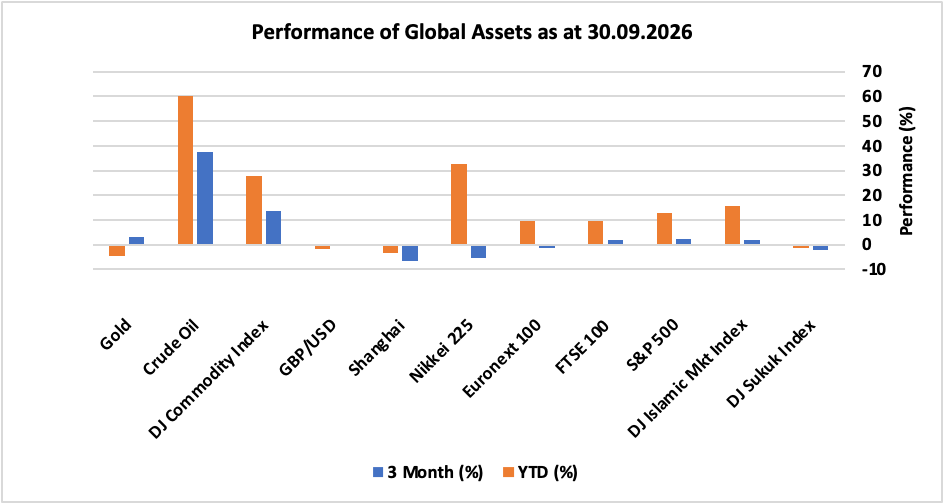
Global financial markets delivered a mixed performance in Q3 2026 as resilient corporate earnings and AI-related investment supported equities, while rising energy prices, higher bond yields and geopolitical tensions increased volatility. The S&P 500 gained around 2.5%, while the FTSE 100 rose 2.0%; the Euronext 100 lost 1.1%, whereas the Nikkei 225 and Shanghai Composite declined approximately 5.3% and 6.6%, respectively. The Dow Jones Islamic Market World Index advanced around 1.9%, while the Dow Jones Sukuk Index fell approximately 2.2% amid the global rise in yields. GBP/USD edged down around 0.11%, while gold gained approximately 3% as geopolitical uncertainty supported safe-haven demand. The Dow Jones Commodity Index strengthened on higher energy prices, with crude oil rising around 37% during the quarter as the US-Iran conflict and supply disruptions pushed Brent above $100/bbl. Overall, equity resilience was supported by AI-led earnings growth, but higher inflation expectations, tighter financial conditions and geopolitical risks constrained broader market gains.
The following snapshot provides a comprehensive breakdown of the performance of different asset classes in Q3 2026, as well as their progress year-to-date.
Performance of global assets – Q3 2026
Portfolio Commentary
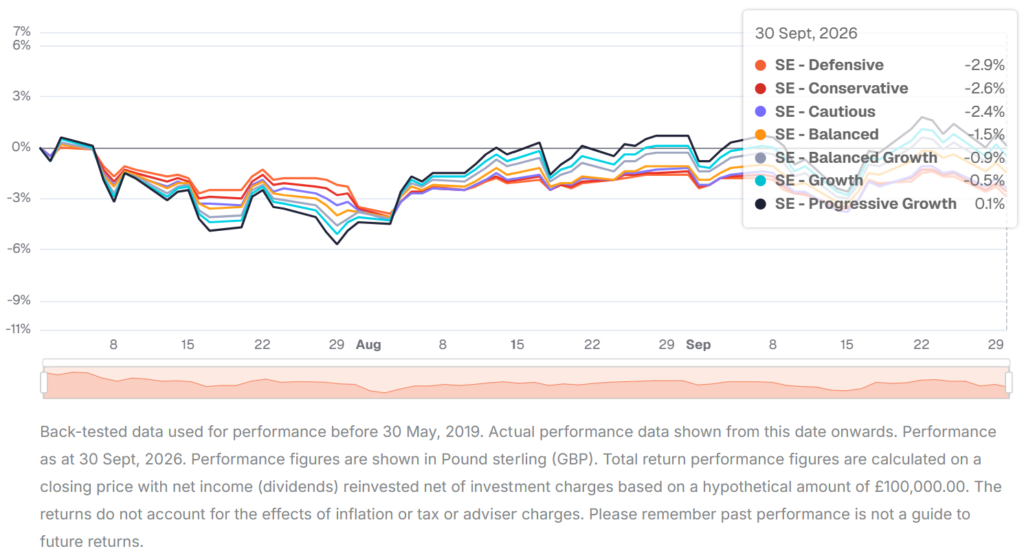
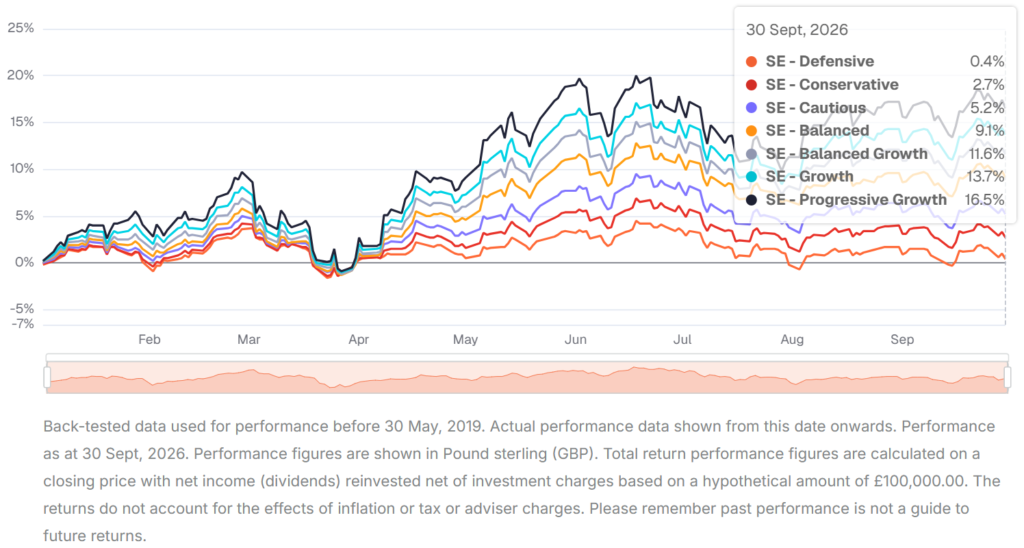
During Q3, all investment portfolios performed negatively, except for Progressive Growth. Our portfolios underperformed compared to the broader market due to our relatively higher exposure to Asian equities across all portfolios and sukuks in higher risk portfolios – both markets were in the negative during the quarter. The Nikkei 225 and Shanghai Composite declined around 5.3% and 6.6%, respectively. The Dow Jones Sukuk Index fell around 2.2% amid the global rise in yields. During the quarter, the 10-year government bond yields rose sharply across major developed economies, reflecting renewed inflation concerns, higher energy prices, resilient economic activity and expectations of interest rates remaining higher for longer. The US 10-year Treasury yield recorded its largest quarterly increase since 2009, rising to around 5.24% by end-September. Despite a negative quarter for all portfolios, the year-to-date performance of all portfolios remain positive. There were no changes made to the investment allocation for any portfolios in the quarter.
Performance of Simply Ethical Online Portfolios in Q2 (01 July 2026 – 30 September 2026)
Year to date 2026 performance of Simply Ethical Online Portfolios (01 January 2026 – 30 September 2026)
We continue to maintain a cautious and measured approach to investment markets, given the combination of elevated valuations, persistent macroeconomic challenges and heightened geopolitical uncertainty. In particular, valuations across parts of the US equity market, especially some of the large technology companies, remain a concern. Investor expectations for future earnings growth and the benefits of artificial intelligence may leave limited room for disappointment. While certain businesses in the sector continue to demonstrate strong competitive positions and growth potential, any moderation in earnings, a reassessment of growth prospects or a shift in market sentiment could lead to increased volatility and downward pressure on share prices.
The macroeconomic outlook has also become more complex, with persistent inflationary pressures, rising energy prices and increasing government borrowing costs adding to market uncertainty. The ongoing conflict involving Iran presents a further risk, particularly if it leads to prolonged disruption to energy supplies, shipping routes or regional instability. A sustained rise in oil prices could push inflation higher, increase costs for businesses and households, and complicate central banks’ efforts to balance price stability with economic growth. This could, in turn, delay anticipated interest rate cuts and weigh on consumer spending and corporate profitability.
At the same time, rising government bond yields in the United States, Japan and the United Kingdom reflect concerns around fiscal sustainability, public debt levels and the future path of interest rates. Higher yields can increase borrowing costs for governments, businesses and households, while also making bonds more attractive relative to equities. This may place further pressure on equity valuations, particularly in growth-oriented sectors where prices are heavily dependent on expectations of future earnings. Policy uncertainty, including potential changes in trade policy, taxation and regulation, adds another layer of complexity for investors.
Taken together, these factors increase the risk of periods of heightened market volatility and potential corrections, particularly if elevated valuations become harder to justify against the prevailing economic and earnings outlook. While we recognise that opportunities will continue to emerge across markets, we believe it is prudent to remain selective in our investment decisions, maintain appropriate diversification and focus on the underlying quality, resilience and valuation of investments. In the current environment, disciplined portfolio construction, careful risk management and a long-term investment perspective remain essential.
To learn more about our investment approach and how we can help you, book a free initial consultation with one of our Financial Advisers.
Disclaimer
This article is for information only. Please do not act based on anything you might read in this article. Past performance is not a reliable indicator of current or future returns. This article contains general information only and does not consider individual objectives, taxation position or financial needs. Nor does this constitute a recommendation of the suitability of any investment strategy for a particular investor. It is not an offer to buy or sell or a solicitation of an offer to buy or sell any security or instrument or to participate in any trading strategy to any person in any jurisdiction in which such an offer or solicitation is not authorised or to any person to whom it would be unlawful to market such an offer or solicitation.
When you access a shared link of third-party websites, you are leaving our website and assume total responsibility and risk for your use of the third-party websites. We make no representation as to the completeness or accuracy of information provided at these websites nor do we endorse the content and information contained on those sites.