
During Q3 2026, global economies and financial markets were influenced by persistent inflationary pressures, elevated energy prices, shifting monetary-policy expectations and heightened geopolitical risks. The escalation of tensions in the Middle East and disruption to energy markets pushed oil and gas prices higher, raising concerns over renewed inflationary pressures and the potential drag on global growth. Major central banks consequently maintained a cautious policy stance, with interest-rate expectations becoming more hawkish and global bond yields moving higher. Tighter financial conditions increased funding costs and contributed to greater volatility across equity, fixed income and currency markets, while trade and tariff uncertainties continued to weigh on global investment and business confidence. Nevertheless, resilient economic activity, robust corporate earnings and continued investment in artificial intelligence provided support to selected equity markets, particularly the US technology sector. Overall, Q3 was characterised by a delicate balance between economic resilience and mounting inflation, energy and geopolitical risks, resulting in a more selective and risk-conscious investment environment.
Macroeconomic Picture
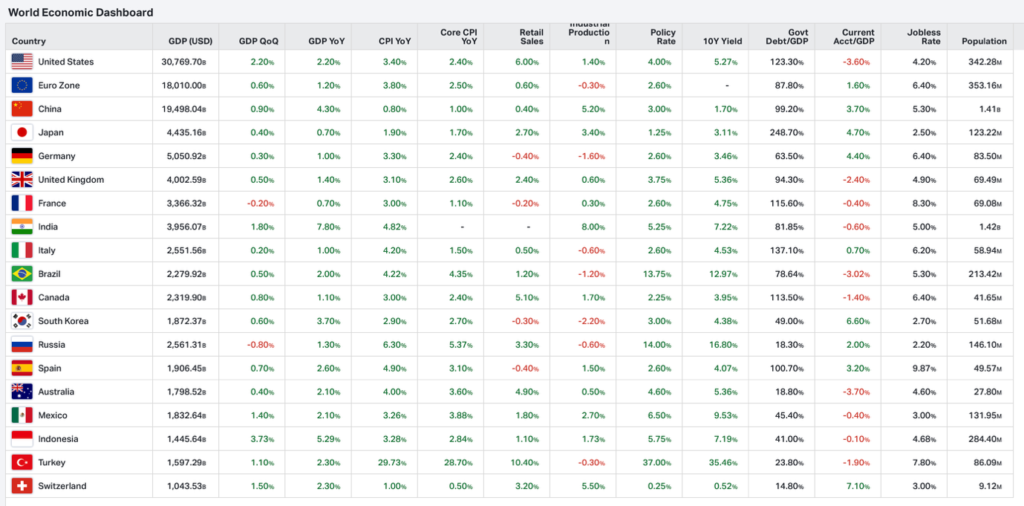
During Q3, global economic activity remained relatively resilient but increasingly divergent across major economies. The UK experienced modest growth momentum, while inflation remained elevated at around 3%, keeping the Bank of England cautious on monetary easing. The EU economy continued to expand moderately, although rising energy prices pushed inflation higher and prompted a more restrictive ECB stance. The US remained the strongest major economy, supported by resilient consumption and investment, but inflation stayed above the Federal Reserve’s 2% target, limiting the scope for rapid rate cuts. Japan continued its gradual recovery, with inflation broadly around the 2% target and a tight labour market supporting further monetary-policy normalisation by the Bank of Japan. China, meanwhile, faced weaker domestic demand and property-sector pressures, with growth slowing from earlier levels despite continued strength in industrial production and high-tech manufacturing. Overall, Q3 was characterised by resilient but uneven growth, renewed inflationary pressures from higher energy costs and cautious monetary-policy settings across major economies.
The following table lists the latest key macroeconomic indicators across major economies (as of 06 October 2026).
Financial Markets Performance
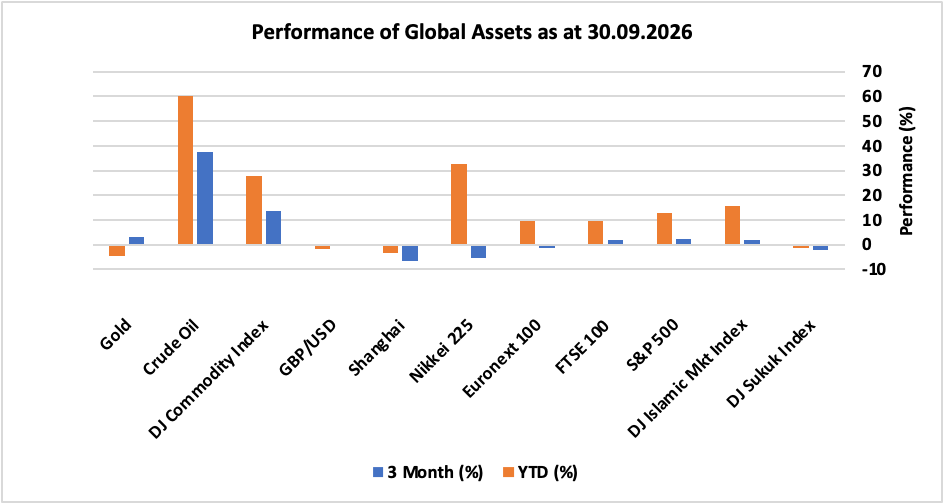
Global financial markets delivered a mixed performance in Q3 2026 as resilient corporate earnings and AI-related investment supported equities, while rising energy prices, higher bond yields and geopolitical tensions increased volatility. The S&P 500 gained around 2.5%, while the FTSE 100 rose 2.0%; the Euronext 100 lost 1.1%, whereas the Nikkei 225 and Shanghai Composite declined approximately 5.3% and 6.6%, respectively. The Dow Jones Islamic Market World Index advanced around 1.9%, while the Dow Jones Sukuk Index fell approximately 2.2% amid the global rise in yields. GBP/USD edged down around 0.11%, while gold gained approximately 3% as geopolitical uncertainty supported safe-haven demand. The Dow Jones Commodity Index strengthened on higher energy prices, with crude oil rising around 37% during the quarter as the US-Iran conflict and supply disruptions pushed Brent above $100/bbl. Overall, equity resilience was supported by AI-led earnings growth, but higher inflation expectations, tighter financial conditions and geopolitical risks constrained broader market gains.
The following snapshot provides a comprehensive breakdown of the performance of different asset classes in Q3 2026, as well as their progress year-to-date.
Performance of global assets – Q3 2026
10 Year Treasury Yields
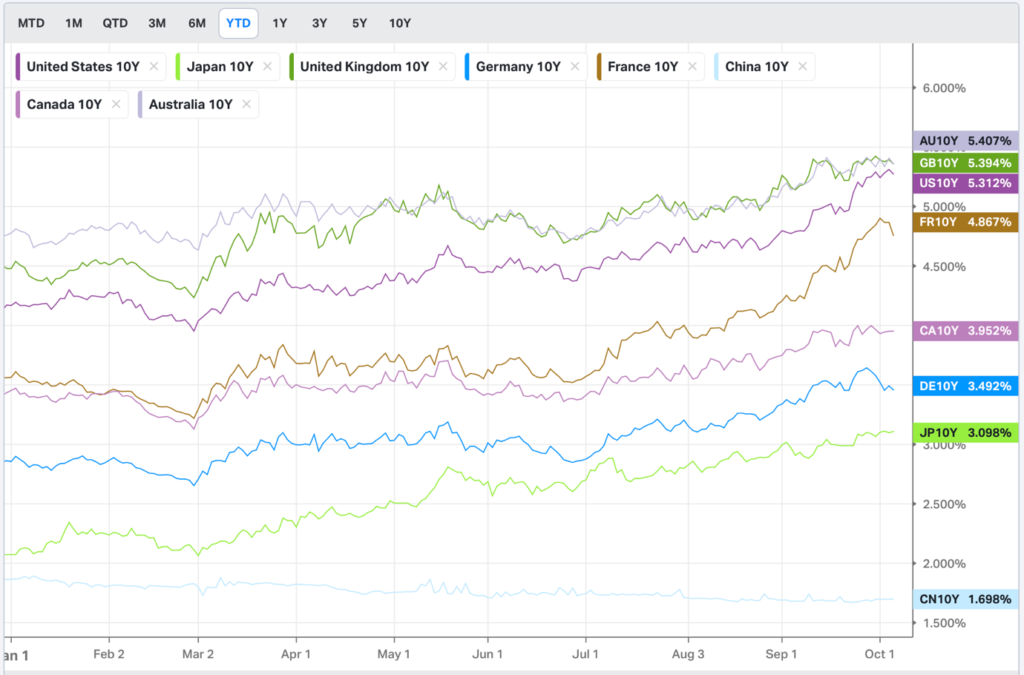
During Q3, 10-year government bond yields rose sharply across major developed economies, reflecting renewed inflation concerns, higher energy prices, resilient economic activity and expectations of interest rates remaining higher for longer. The US 10-year Treasury yield recorded its largest quarterly increase since 2009, rising to around 5.24% by end-September. The UK 10-year gilt yield increased to approximately 5.40%, while the German Bund yield climbed to around 3.57%, as European inflation expectations strengthened. Japan’s 10-year JGB yield also moved higher to approximately 3.06%, reaching levels not seen since the mid-1990s. Overall, the broad rise in sovereign yields resulted in losses across global fixed-income markets and reflected a substantial repricing of inflation, monetary-policy and fiscal risks during the quarter.
Source: Koyfin
Geopolitical Situation
Q3 2026 remained characterised by significant geopolitical risks, with direct implications for global markets. US-China trade tensions eased following renewed negotiations and tariff reductions, supporting expectations for improved global trade and risk sentiment. US-Iran tensions remained the most significant market risk, with disruptions to the Strait of Hormuz keeping Brent crude above $100/bbl and increasing inflation concerns, particularly for energy-importing economies. The Russia-Ukraine conflict continued to disrupt energy infrastructure and fuel supplies, adding further pressure to European energy markets. In Gaza, continued Israel-Hamas hostilities and ceasefire efforts maintained uncertainty across regional markets. Overall, geopolitical tensions supported oil and gold prices, increased inflation expectations and bond yields, while contributing to greater volatility across global equities and currencies.
Key News & Events in Q3 2026
UK
- The UK’s annual inflation rate rose to 3.1% in August 2026, its highest level in five months, up from 2.9% in July and broadly in line with market expectations. Transport costs made the largest upward contribution, with inflation accelerating to 4.6% from 3.6%, driven mainly by motor fuels.
- The Bank of England’s Monetary Policy Committee voted 6–3 to maintain Bank Rate at 3.75% at its September 16, 2026 meeting, in line with expectations. Three members again favoured a 25-basis-point increase to 4%, unchanged from the July meeting.
- The UK economy grew 0.5% quarter-on-quarter in Q2 2026, revised up from the previous estimate of 0.4%, following 0.6% growth in Q1.
- The UK unemployment rate remained unchanged at 4.9% for the fourth consecutive period in the three months to July 2026, defying expectations of a rise to 5.0%.
US
- US annual inflation held steady at 3.4% in August 2026, unchanged from July and broadly in line with market expectations.
- The Federal Reserve unanimously raised the federal funds target range by 25 bps to 3.75%–4.00% in September 2026, as expected, marking its first rate hike since 2023. Policymakers cited persistent inflationary pressures and the need to support a timely return to the 2% target.
- The US economy expanded at an annualized 2.2% rate in Q2 2026, revised up by 0.7 percentage point from the second estimate, following upwardly revised 2.5% growth in Q1. The revision reflected stronger investment, consumer spending, and government expenditure.
- The US unemployment rate edged up to 4.2% in September 2026 from 4.1% in August, slightly exceeding market expectations of 4.1%.
Europe
- Eurozone annual inflation accelerated to 3.8% in September 2026 from 3.2% in August, exceeding expectations of 3.6%, according to preliminary estimates. It reached its highest level since September 2023, driven largely by surging energy prices amid continued conflict in the Middle East.
- The European Central Bank raised key interest rates by 25 bps at its September meeting, marking its second hike since the US-Iran war began. The ECB highlighted persistent Middle East-related inflationary pressures and expected inflation to remain above its 2% target for an extended period.
- The Eurozone economy grew 0.6% in Q2 2026, revised up from the initial 0.4% estimate, according to final Eurostat data. This marked the strongest quarterly growth since Q2 2022, largely reflecting a sharp upward revision to Ireland’s GDP, which surged 10.2% after contracting 7.8% in Q1.
- The Eurozone’s seasonally adjusted unemployment rate remained at 6.4% in August 2026, unchanged since February and broadly in line with analysts’ expectations.
China
- China’s annual inflation increased to 0.8% in August 2026 from July’s six-month low of 0.5%, in line with market expectations. Non-food inflation accelerated to 1.2% from 0.9%, led by higher transport costs amid rising fuel prices and stronger travel demand.
- The People’s Bank of China kept its key lending rates at record lows for a 16th consecutive month in September 2026, despite a strengthening yuan and rate hikes by several other central banks, in line with expectations.
- China’s economy grew 0.9% quarter-on-quarter in Q2 2026, matching market expectations but slowing from 1.3% growth in Q1. It was the weakest quarterly expansion since Q2 2024, as subdued domestic demand and the oil shock linked to the Iran war offset resilient exports.
China’s surveyed urban unemployment rate rose to 5.3% in August 2026 from 5.2% in July, exceeding expectations of 5.2% and reaching its highest level since March.China’s surveyed urban unemployment rate edged lower to 5.1% in May 2026, compared with both market expectations and the previous month’s 5.2%. It marked the lowest reading since December 2025.
To learn more about our investment approach and how we can help you, book a free initial consultation with one of our Financial Advisers.
Disclaimer
This article is for information only. Please do not act based on anything you might read in this article. Past performance is not a reliable indicator of current or future returns. This article contains general information only and does not consider individual objectives, taxation position or financial needs. Nor does this constitute a recommendation of the suitability of any investment strategy for a particular investor. It is not an offer to buy or sell or a solicitation of an offer to buy or sell any security or instrument or to participate in any trading strategy to any person in any jurisdiction in which such an offer or solicitation is not authorised or to any person to whom it would be unlawful to market such an offer or solicitation.
When you access a shared link of third-party websites, you are leaving our website and assume total responsibility and risk for your use of the third-party websites. We make no representation as to the completeness or accuracy of information provided at these websites nor do we endorse the content and information contained on those sites.