

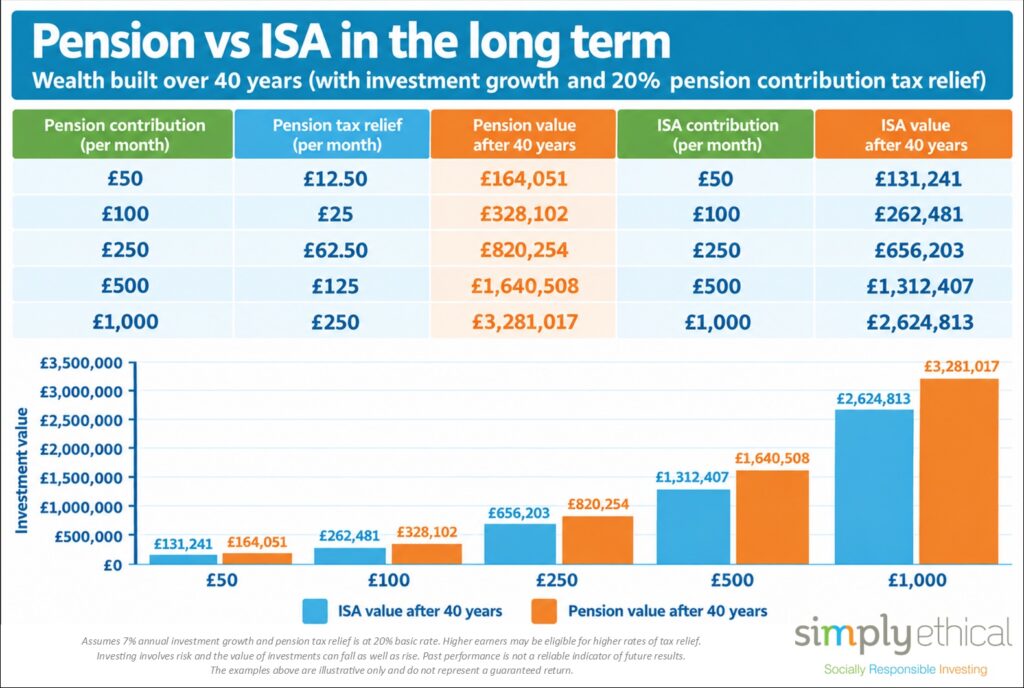
If you’re trying to save for the future, two of the most useful tax-efficient options in the UK are Pensions and ISAs.
Both can help your money grow without being eaten away by tax, but they work in very different ways.
The simplest way to think about it is this:
A pension is primarily designed for money you won’t need until later in life. An ISA is designed to give you tax-efficient savings and investments that you can access whenever you need them.
So which one should you use?
For many people, the answer isn’t either/or. A combination of the two likely makes the most sense.
What is a pension?
A pension is also a tax-efficient investment wrapper, but it comes with more restrictions.
The big attraction is tax relief on contributions.
For example, suppose you’re a basic-rate taxpayer and want £10,000 to go into a pension. With a typical “relief at source” pension, you might pay £8,000 and the government adds £2,000 in tax relief, making £10,000 in the pension. Higher-rate taxpayers may be able to claim additional relief – up to a total of 45% relief – depending on their circumstances, and how their pension scheme works.
Workplace pensions can be even more attractive because your employer may contribute as well. Some employers also offer salary sacrifice arrangements, which can provide additional National Insurance advantages under current rules.
This is one reason it’s often difficult for an ISA to compete with a pension when you’re saving specifically for retirement.
What is an ISA?
An Individual Savings Account, or ISA, is a tax-efficient wrapper around your savings or investments.
There are several types, including Cash ISAs and Stocks and Shares ISAs. In a Cash ISA, you can earn interest (or profit from Islamic providers) without paying tax on it. In a Stocks and Shares ISA, investment income and capital gains are generally free from UK tax.
For the 2026/27 tax year, the overall ISA allowance is £20,000. You can put up to that amount into ISAs during the tax year, subject to the rules for the particular type of ISA.
One of the biggest advantages is flexibility.
Unlike a pension, you can normally withdraw money from an ISA whenever you want without losing its tax advantages.
That makes ISAs particularly useful for goals such as:
- Building a house deposit
- Saving for a wedding
- Creating an early-retirement fund
- Investing for your children’s future
- Keeping a financial safety net beyond your emergency fund
The big trade-off: tax relief versus access
This is probably the most important difference.
Pension: You get valuable tax benefits when putting money in, but generally can’t access it until you reach the relevant minimum pension age.
ISA: You don’t get tax relief when you put money in, but you can normally take it back out whenever you like, tax-free.
In other words:
Pension = greater upfront tax benefits, less flexibility.
ISA = less upfront tax benefit, much greater flexibility.
The normal minimum pension age is currently 55, but it is scheduled to rise to 57 from 6 April 2028, subject to the applicable rules and protections.
That restriction can be a disadvantage if you want to retire early.
Imagine you’re 40 and want to stop working at 50. A pension may contain plenty of money for your later retirement, but you need another source of income to bridge the period before you can access it.
An ISA can be extremely useful for that “bridge”.
What happens when you eventually take the money?
This is where pensions become slightly more complicated.
You can usually take up to 25% of your pension benefits tax-free, subject to the lump sum allowance. For 2026/27, the standard lump sum allowance is £268,275.
The rest of your pension withdrawals are generally taxable as income.
That doesn’t necessarily mean you’ll pay more tax overall. The idea is that you receive tax relief while working and potentially pay tax later, when your income may be lower.
An ISA works differently.
You don’t normally get tax relief when you contribute, but qualifying ISA withdrawals are not subject to Income Tax or Capital Gains Tax.
So, broadly:
| ISA | Pension | |
| Tax relief when contributing | No | Yes, subject to rules |
| Investment growth | Tax-efficient | Tax-efficient |
| Withdrawals | Generally tax-free | Generally taxable, apart from available tax-free amounts |
| Access | Generally any time | Normally restricted until minimum pension age |
| Employer contributions | No | Often available through workplace pensions |
| Annual allowance | £20,000 ISA allowance | £60,000 pension annual allowance in 2026/27, subject to individual circumstances |
| Best suited to | Flexible savings and investing | Long-term retirement saving |
The pension annual allowance is currently £60,000 for 2026/27, although it can be lower in certain circumstances, including for particularly high earners and people who have already flexibly accessed a pension. Unused allowance may also be carried forward from the previous three tax years, subject to the rules.
So which should you choose?
For most people, the answer starts with the workplace pension.
If your employer offers a pension contribution, particularly if they will contribute more when you contribute more, it’s usually worth understanding that scheme before prioritising an ISA. Turning down an employer contribution can mean leaving part of your remuneration on the table.
After that, the decision becomes more personal.
A pension may be particularly attractive if:
- You’re saving specifically for retirement.
- You’re receiving employer contributions.
- You’re a higher-rate taxpayer and can benefit from additional pension tax relief.
- You don’t expect to need the money before retirement age.
- You’re happy to accept restrictions in exchange for tax advantages.
An ISA may be particularly attractive if:
- You want access to your money before pension age.
- You’re building savings for a medium- or long-term goal.
- You want an early-retirement fund.
- You’ve already made substantial pension contributions.
- You value flexibility and simplicity.
One important change coming to ISAs
There’s a significant ISA change planned for 6 April 2027.
For people under 65, the annual Cash ISA limit is due to fall to £12,000, while the overall ISA allowance remains £20,000. The Stocks and Shares ISA and Innovative Finance ISA limits will remain at £20,000. People aged 65 and over will retain a £20,000 Cash ISA limit.
That means the distinction between “saving in cash” and “investing for the long term” is becoming increasingly important for ISA savers.
The bottom line
Think of your pension as your long-term retirement engine and your ISA as your flexible financial toolbox.
If you’re employed, first understand your workplace pension and make sure you’re not missing out on employer contributions. Then consider how much additional money you want locked away for retirement versus how much you might want available earlier.
For someone who wants to retire at 65 and has a workplace pension, putting more into a pension can be very attractive.
For someone who wants the option to retire at 55, buy a property, take a career break or simply have accessible investments, an ISA can be extremely valuable.
And for many people, the best strategy isn’t choosing one over the other.
Use the pension for money you are confident you won’t need until later in life, and use an ISA for money where flexibility matters.
That combination can give you both tax efficiency and financial freedom.
For a personal decision, the key variables would be your age, income/tax band, employer pension contribution, existing pension/ISA savings and when you expect to need the money.
How Simply Ethical can help
If you are looking to build your wealth in a Sharia-compliant manner, Simply Ethical offers both an ISA and Pension, along with GIAs, JISAs and more.
Simply Ethical’s Simplified Advice Online service offers 7 model portfolios to invest in, with competitive fees of just 0.75% per annum.
You will have 24/7 access via your online account, with your investments actively managed by our experienced investment team.
Start your investment journey with Simply Ethical today, sign up here. Or book a free 15-minute consultation with a member of our team here.
Disclaimer
This article is for information only. Please do not act based on anything you might read in this article. Past performance is not a reliable indicator of current or future returns. This article contains general information only and does not consider individual objectives, taxation position or financial needs. Nor does this constitute a recommendation of the suitability of any investment strategy for a particular investor. It is not an offer to buy or sell or a solicitation of an offer to buy or sell any security or instrument or to participate in any trading strategy to any person in any jurisdiction in which such an offer or solicitation is not authorised or to any person to whom it would be unlawful to market such an offer or solicitation.
When you access a shared link of third-party websites, you are leaving our website and assume total responsibility and risk for your use of the third-party websites. We make no representation as to the completeness or accuracy of information provided at these websites nor do we endorse the content and information contained on those sites.