

Overview
During October 2026, global financial markets remained under pressure from persistent inflation, elevated energy prices, trade uncertainty and geopolitical tensions. The US-Iran conflict and renewed threats to shipping through the Strait of Hormuz kept oil prices elevated, reinforcing inflationary concerns, particularly across energy-importing economies. Although global economic activity remained relatively resilient, sticky inflation and higher energy costs strengthened expectations of interest rates remaining higher for longer, keeping sovereign bond yields and borrowing costs elevated. The US Federal Reserve maintained interest rates at its October meeting, adopting a cautious approach amid persistent inflation risks. Meanwhile, the extension of the US-China trade truce offered some relief to global trade sentiment, although broader tariff and strategic uncertainties remained unresolved. Equity markets also faced intermittent volatility as investors reassessed elevated technology valuations and the sustainability of AI-related capital expenditure. Overall, the combination of energy-driven inflation, restrictive monetary conditions and geopolitical uncertainty encouraged a more cautious and selective investment approach.
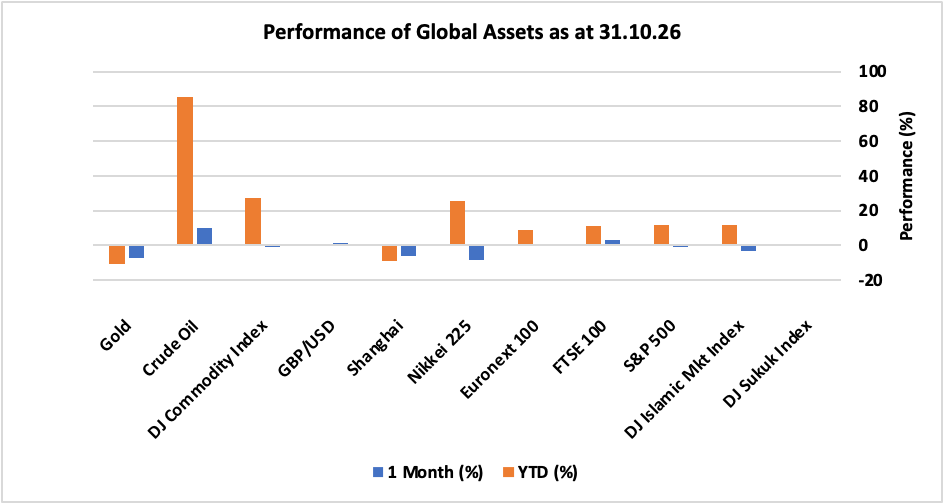
Looking at performance in October, global financial assets delivered a mixed performance, with UK and European equities gaining while U.S. and Asian markets largely declined amid shifting macroeconomic and geopolitical dynamics. Commodities remained under pressure, with the DJ Commodity Index declining around 1%, despite crude oil rising nearly 10%, while gold fell approximately 7.3%. The S&P 500 declined around 1%, while the DJ Islamic Markets Index lost approximately 3.3%, reflecting increased market volatility and investor caution as concerns over elevated AI valuations, rising technology-sector capital expenditure and uncertain investment returns triggered a sell-off in technology and growth stocks. Japan’s Nikkei 225 fell nearly 8.2%, while China’s Shanghai Index declined around 6.3%. Japanese and Chinese equities declined amid a broader sell-off in technology and semiconductor stocks, concerns over elevated AI valuations and investment returns, and persistent weakness in China’s domestic demand. Conversely, the UK FTSE 100 gained approximately 3%, while Europe’s Euronext 100 edged up around 0.9%. UK and European equities gains supported by strength in energy, healthcare and defensive stocks, alongside resilient corporate earnings, which helped offset concerns over inflation and European political and fiscal uncertainty. On the fixed-income side, the DJ Sukuk Index recorded a modest gain of around 1% as yields softened later in the month. Finally, sterling strengthened 1.5% against the U.S. dollar.
The following snapshot provides a detailed breakdown of the performance of different asset classes in October 2026, as well as their progress year-to-date, offering a comprehensive overview of market dynamics during a period marked by both optimism and lingering uncertainty.
Market Snapshot
News & Key Events in October:
UK
- The UK’s annual inflation rate rose to 3.5% in September 2026, its highest since October 2025, from 3.1% in August and above expectations of 3.4%. Transport made the largest upward contribution, with inflation rising to 6.6% from 4.6%, driven mainly by motor fuels.
- The UK economy expanded by 0.5% quarter-on-quarter in Q2 2026, revised up from 0.4% in the previous estimate, following 0.6% growth in Q1. Services output rose 0.6% (vs 0.7% in Q1), led by professional, scientific and technical activities, which increased 2.3%, and information and communication, which grew 2.5%.
- The UK unemployment rate fell to 4.7% in the three months to August 2026, defying market expectations that it would remain unchanged at 4.9% for the fifth consecutive period.
US
- The US annual inflation rate accelerated to 3.7% in September 2026, up from 3.4% in each of the previous two months and above market expectations of 3.6%, driven by higher energy prices.
- The Federal Reserve left the federal funds rate unchanged at 3.75%–4.00% at its October 2026 meeting, following a 25bps hike in September, which was the first rate increase since 2023. The decision came in line with market expectations, but two policymakers voted for a 25bps rate hike.
- The US economy expanded an annualized 3.4% in Q3 2026, the most in a year, compared to a 2.2% rise in Q2 and above expectations of 3.2%.
- The US unemployment rate rose to 4.2% in September 2026, up from 4.1% in August and slightly above market expectations of 4.1%.
Europe
- The annual inflation rate in the Eurozone accelerated for a third consecutive month to 3.8% in September 2026, the highest since September 2023, compared to 3.2% in August and in line with the preliminary estimate, driven largely by a surge in energy prices amid continued fighting in the Middle East.
- The European Central Bank left interest rates unchanged at its October 2026 meeting, as expected, keeping the main refinancing rate at 2.65% and the deposit facility rate at 2.50%. The central bank warned that elevated energy prices could fuel inflation while weighing on economic activity.
- The Eurozone economy expanded by 0.4% in Q3 2026, slowing from 0.6% growth in Q2 but exceeding market expectations of 0.2%, according to preliminary estimates. Ireland led the region with growth of 5.5%, driven by strong AI-related investments.
- Unemployment Rate in the Euro Area remained unchanged at 6.50 percent in September.
China
- China’s annual inflation rate edged up to 0.9% in September 2026 from 0.8% in August, slightly below market expectations of 1%. It marked the highest reading since June, with non-food inflation accelerating (1.5% vs 1.2% in August), driven by a sharper rise in transport costs.
- The People’s Bank of China kept its key lending rates at record lows for the 17th straight month in October 2026, even as the yuan continued to strengthen amid strong economic data that met expectations.
- China’s economy advanced 1.2% qog in Q3 2026, above market estimates of 1.1% and up from 0.9% in Q2. Stronger activity ahead of and during the Golden Week holiday period supported growth, alongside incremental policy support from Beijing.
- China’s surveyed urban unemployment rate edged down to 5.2% in September 2026, compared to market expectations and August’s five-month high of 5.3%.
Others
- Japan’s annual inflation rate accelerated to 2.1% in September 2026 from 1.9% in the previous two months, marking the highest level since December 2025.
- The Bank of Japan kept its short-term policy rate unchanged at 1.25% in an 8-1 vote at its October meeting, in line with market expectations. The decision followed two consecutive 25bp hikes in June and September, leaving borrowing costs at their highest level since April 1995.
- The headline inflation rate in Canada rose to 3.1% in September of 2026 from 3.0% in the previous month, the highest reading since the two-year high of 3.2% in May, but below the market consensus of 3.2%.
- The Bank of Canada raised its benchmark policy rate by 25bps to 2.5% in October 2026, the first increase in three years and in line with market expectations. Policymakers said the decision aims to reduce the risk that continuing high energy prices spread broadly to the prices of other goods and services.
- Russia’s annual inflation rate edged up to 6.35% in September 2026 from 6.33% in the previous month.
The Bank of Russia kept its key interest rate unchanged at 14% in October, in line with market expectations, as inflationary pressures and elevated expectations continued to hinder disinflation.
Disclaimer
This article is for information only. Please do not act based on anything you might read in this article. Past performance is not a reliable indicator of current or future returns. This article contains general information only and does not consider individual objectives, taxation position or financial needs. Nor does this constitute a recommendation of the suitability of any investment strategy for a particular investor. It is not an offer to buy or sell or a solicitation of an offer to buy or sell any security or instrument or to participate in any trading strategy to any person in any jurisdiction in which such an offer or solicitation is not authorised or to any person to whom it would be unlawful to market such an offer or solicitation.
When you access a shared link of third-party websites, you are leaving our website and assume total responsibility and risk for your use of the third-party websites. We make no representation as to the completeness or accuracy of information provided at these websites nor do we endorse the content and information contained on those sites.