

Overview
In July 2026, global financial markets were influenced by a combination of evolving macroeconomic conditions, renewed trade policy uncertainty, and persistent geopolitical tensions. Investors closely monitored inflation and labour market data for clues on the pace of monetary policy easing, while central banks maintained a cautious, data-dependent approach. Trade negotiations and selective tariff measures among major economies continued to create uncertainty for global manufacturing, technology supply chains, and export-oriented industries. Meanwhile, the ongoing Russia–Ukraine conflict and instability in the Middle East sustained demand for safe-haven assets. Equity markets generally remained mixed amid resilient corporate earnings, particularly within AI-driven technology sectors, offset by Asia markets’ leverage trade and China tech advancements, while commodity prices remained volatile in response to geopolitical developments. Overall, July was characterised by cautious optimism as investors balanced improving economic fundamentals against lingering trade and geopolitical risks.
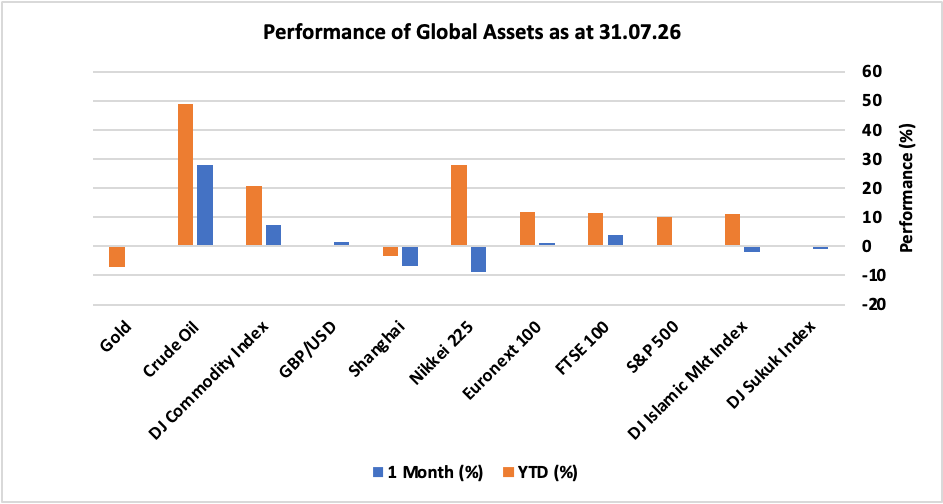
Looking at the performance, major global financial assets experienced a mixed performance where European equities delivered positive while Asian equity markets declined amid huge leverage trade unwinding, while commodities rose due to oil surge amid conflicts in the Middle East. UK FTSE 100 rose 3.8% whereas Europe’s Euronext 100 rose by 1% during the month. On the other hand, US S&P 500 remained flat while DJ Islamic Markets Index declined by 1.9%. Japan’s Nikkei 225 plunged by 8.6% followed by China’s Shanghai that fell 6.8%, impacted by US tech sell-off as well as huge leverage positions. DJ Sukuk Index ended the month down 0.8% as yields swollen. Commodities surged sharply as DJ Commodity index rose by 7.2% driven by over 28% incrase in Crude oil prices while gold increased by 0.2%. Lastly, UK pound appreciated by 1.53% against the US dollar.
The following snapshot provides a detailed breakdown of the performance of different asset classes in July 2026, as well as their progress year-to-date, offering a comprehensive overview of market dynamics during a period marked by both optimism and lingering uncertainty.
Market Snapshot
News & Key Events in July:
UK
- The annual inflation rate in the UK eased to 2.6% in June 2026 from 2.8% in May, slowing more than the expected fall to 2.7%.
- The Bank of England left its Bank Rate unchanged at 3.75% at its July meeting, with a 6-3 majority in favour of holding rates steady, while three policymakers preferred a 25-basis-point increase to 4.0%.
- The UK economy expanded by 0.6% quarter-on-quarter in Q1 2026, confirming preliminary estimates and accelerating from a revised 0.1% growth in Q4. This marked the strongest quarterly expansion since Q1 2025.
- The UK unemployment rate was unchanged at 4.9% in the three months to May 2026, unexpectedly defying expectations that it would rise to 5.0%.
US
- The annual inflation rate in the US fell to 3.5% in June 2026, the first decline in five months, compared to 4.2% in May and below forecasts of 3.8%. Energy costs increased 15.7%, below 23.5% in May, as the ceasefire between the US and Iran alleviated inflationary pressures from the energy component.
- The Federal Reserve left the federal funds rate unchanged at 3.50%–3.75% for a fifth consecutive meeting in July 2026, in line with expectations, despite markets assigning roughly a one-in-three probability to a rate hike.
- The US economy expanded an annualized 1.5% in Q2 2026, below 2.1% in Q1 and forecasts of 2.1% the advance estimate from the BEA showed.
- The US unemployment rate dropped to 4.2% in June 2026, down from 4.3% in May and below expectations, as many people left the workforce.
Europe
- Eurozone annual inflation accelerated to 2.9% in July 2026, in line with market expectations, up from 2.8% in June and remaining well above the European Central Bank’s 2.0% target, according to preliminary estimates.
- The European Central Bank left its key interest rates unchanged at its July meeting, following a 25bp increase in June, the first rate hike in three years, driven by rising energy prices and persistent inflationary pressures.
- The eurozone economy expanded by 0.4% in the second quarter of 2026, accelerating from flat growth in the previous quarter and beating market expectations of a 0.2% increase, according to preliminary estimates.
- The seasonally adjusted unemployment rate in the Eurozone was at 6.3% for the fourth straight month in June of 2026, slightly under market expectations that it would be at a record low of 6.2%.
China
- China’s annual inflation eased to 1.0% in June 2026 from 1.2% in both April and May, slightly below market expectations of 1.1%, marking the softest increase in three months.
- The People’s Bank of China kept its key lending rates at record lows for a 14th straight month in July 2026, as widely expected. The move reflected caution over the fallout from the conflict in the Middle East, while Q2 GDP growth eased to its lowest level since Q4 2022, although exports remained strongly supported by AI-related demand.
- China’s economy grew 0.9% qoq in Q2 2026, matching market expectations but easing from a 1.3% gain in Q1. It was the weakest quarterly growth since Q2 2024, as soft domestic demand and the oil shock linked to the Iran war offset resilient exports.
- China’s surveyed urban unemployment rate edged down to 5.0% in June 2026, in line with market expectations and down from 5.1% in the prior month.
Others
- Japan’s annual inflation rate accelerated to 1.7% in June 2026 from 1.5% in the prior month, marking the highest reading since December.
- The Bank of Japan kept its short-term policy rate unchanged at 1.0% at its July 2026 meeting, leaving borrowing costs at their highest level since September 1995 after raising the rate by 25bps in June, as the board warned that underlying inflation could exceed the 2% target.
- The headline inflation rate in Canada fell to 2.8% in June of 2026 from the over-two-year high of 3.2% in the previous month, slightly under market expectations of 2.9%.
- The Bank of Canada left the target for its overnight rate unchanged at 2.25% for a sixth consecutive decision in July 2026, in light with expectations.
- The headline inflation rate in Russia rose to 6.0% in June of 2026 from 5.3% in the previous month, the highest since January, and contrasting with most major economies that are seeing consumer inflation slow after the initial surge driven by the war in the Middle East.
The Bank of Russia cut its policy rate by 25bps to 14.0% in its July 2026 decision, to extend its cutting cycle since the rate was at a record high of 21% up to June of last year.
Disclaimer
This article is for information only. Please do not act based on anything you might read in this article. Past performance is not a reliable indicator of current or future returns. This article contains general information only and does not consider individual objectives, taxation position or financial needs. Nor does this constitute a recommendation of the suitability of any investment strategy for a particular investor. It is not an offer to buy or sell or a solicitation of an offer to buy or sell any security or instrument or to participate in any trading strategy to any person in any jurisdiction in which such an offer or solicitation is not authorised or to any person to whom it would be unlawful to market such an offer or solicitation.
When you access a shared link of third-party websites, you are leaving our website and assume total responsibility and risk for your use of the third-party websites. We make no representation as to the completeness or accuracy of information provided at these websites nor do we endorse the content and information contained on those sites.