
Overview
Global financial markets remained sensitive to a combination of macroeconomic uncertainty, tariff policies and geopolitical tensions throughout August 2026. Persistent inflationary pressures, particularly from energy costs, kept investors focused on the future path of interest rates and central-bank policy. US tariff measures and continuing trade tensions, including further restrictions involving China and Canada, increased concerns about supply chains, corporate costs and global economic growth. At the same time, geopolitical tensions in the Middle East and disruptions to energy flows contributed to higher oil prices and renewed inflation fears. These developments created volatility across equities, bonds, currencies and commodities, while investors continued to favour defensive assets such as gold. Overall, August highlighted the increasingly interconnected impact of monetary policy, trade protectionism and geopolitical risk on global market sentiment.
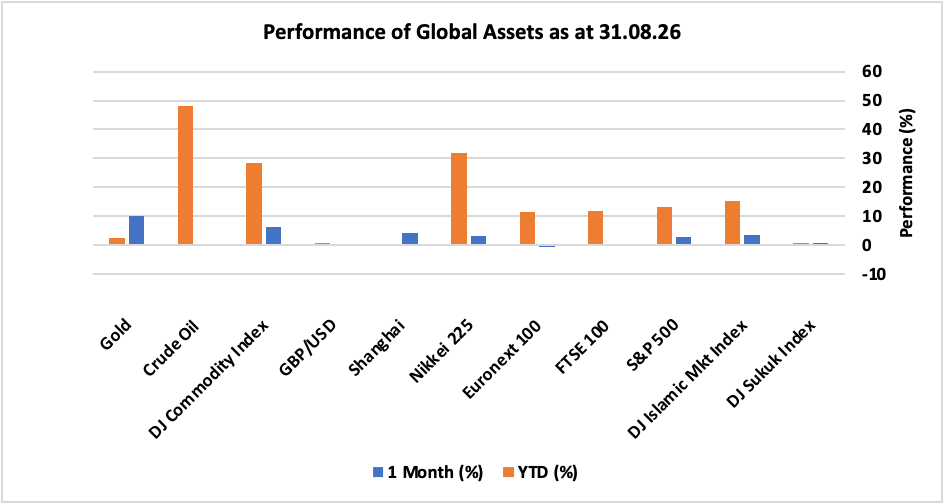
Looking at the performance, major global financial assets experienced a mixed performance where Asian and U.S equities delivered positive while European equity markets declined amid rapidly changing macro and geopolitical dynamics, while commodities rose over 6% due to 10% positive performance by gold amid conflicts in the Middle East. China’s Shanghai delivered over 4% followed by Japan’s Nikkei 225 that rose by just over 3%. US S&P 500 jumped by 2.7% while DJ Islamic Markets Index surged by 3.6% supported by strong corporate earnings from big tech as well as software stocks. On the other hand, UK FTSE 100 delivered only 0.2% whereas Europe’s Euronext 100 declined by 0.5% during the month impacted by surging inflation amid higher oil prices. DJ Sukuk Index ended the month up 0.75% as yields took a breather. Lastly, UK pound appreciated by 0.5% against the US dollar.
The following snapshot provides a detailed breakdown of the performance of different asset classes in August 2026, as well as their progress year-to-date, offering a comprehensive overview of market dynamics during a period marked by both optimism and lingering uncertainty.
Market Snapshot
News & Key Events in August:
UK
- The UK’s annual inflation rate rose to 2.9% in July 2026, the highest in four months, from 2.6% in June and in line with market expectations.
- The Bank of England left its Bank Rate unchanged at 3.75% at its July meeting, with a 6-3 majority in favour of holding rates steady, while three policymakers preferred a 25-basis-point increase to 4.0%.
- The UK economy expanded by 0.4% quarter-on-quarter in Q2 2026, slowing from 0.6% growth in Q1, in line with market expectations, preliminary estimates showed.
- The UK unemployment rate was unchanged at 4.9% in the three months to June 2026, defying expectations for a decline to 4.8%, as firms delayed hiring amid uncertainty over domestic and global developments.
US
- The annual inflation rate in the US slowed for a second consecutive month to 3.4% in July 2026, from 3.5% in June, in line with expectations. Inflation moved further below the 2023 high of 4.2% reached in May, as the impact of the energy shock caused by the war with Iran continued to ease.
- The Federal Reserve’s July meeting minutes showed that policymakers remained concerned about persistent inflation and the possibility that further rate increases could be required if price pressures fail to ease.
- The US economy expanded at an annualized rate of 1.5% in the second quarter of 2026, slowing from 2.1% in the previous quarter and matching the preliminary estimate.
- The US unemployment rate dropped to 4.1% in July 2026, down from 4.2% in June and below expectations, as many people left the workforce.
Europe
- Eurozone annual inflation accelerated to 3.3% in August 2026 from 2.9% in July, in line with market expectations, according to preliminary estimates. The rate reached its highest level since September 2023 and remained well above the ECB’s 2% target, driven largely by a surge in energy prices amid continued fighting in the Middle East.
- All ECB policymakers agreed to leave rates unchanged at the July meeting, following the first rate hike since 2023 in June, citing elevated uncertainty and the fact that the full inflationary impact of the energy shock had yet to emerge, according to the latest minutes.
- The Eurozone economy expanded by 0.4% in the second quarter of 2026, in line with flash data and accelerating from flat growth in the previous quarter, second estimates showed.
- The Eurozone’s seasonally adjusted unemployment rate held at 6.4% in July, matching June’s revised reading and slightly above the 6.3% forecast.
China
- China’s annual inflation eased to 0.5% in July 2026 from 1.0% in the prior month, falling short of market forecasts of 0.8%. It was the lowest print since January, as food prices continued to decline while non-food inflation slowed further.
- The People’s Bank of China kept its key lending rates at record lows for a 15th straight month in August 2026, in line with market expectations. The move reflected caution over the impact of the conflict in the Middle East, while Q2 GDP growth eased to its lowest level since Q4 2022, although exports remained strongly supported by AI-related demand.
- China’s economy grew 0.9% qoq in Q2 2026, matching market expectations but easing from a 1.3% gain in Q1. It was the weakest quarterly growth since Q2 2024, as soft domestic demand and the oil shock linked to the Iran war offset resilient exports.
- China’s economy grew 0.9% qoq in Q2 2026, matching market expectations but easing from a 1.3% gain in Q1. It was the weakest quarterly growth since Q2 2024, as soft domestic demand and the oil shock linked to the Iran war offset resilient exports.
Others
- Japan’s annual inflation rate accelerated to 1.9% in July 2026 from a marginally revised 1.6% in the previous month, marking the highest reading since December 2025.
- The Bank of Japan kept its short-term policy rate unchanged at 1.0% at its July 2026 meeting, leaving borrowing costs at their highest level since September 1995 after raising the rate by 25bps in June, as the board warned that underlying inflation could exceed the 2% target.
- The headline inflation rate in Canada inched higher to 3% in July of 2026 from 2.8% in the previous month, slightly above market expectations of 2.9%, but remaining below the post-Iran-war peak of 3.2% from two months prior.
- The Bank of Canada maintained the target for its overnight rate unchanged at 2.25% in its September 2026 decision, as expected by markets, but flagged stronger upside risks to inflation.
- Russia’s annual inflation rate held at 6.0% in July 2026, matching June’s reading and remaining at its highest level since January.
The Bank of Russia cut its policy rate by 25bps to 14.0% in its July 2026 decision, to extend its cutting cycle since the rate was at a record high of 21% up to June of last year.
Disclaimer
This article is for information only. Please do not act based on anything you might read in this article. Past performance is not a reliable indicator of current or future returns. This article contains general information only and does not consider individual objectives, taxation position or financial needs. Nor does this constitute a recommendation of the suitability of any investment strategy for a particular investor. It is not an offer to buy or sell or a solicitation of an offer to buy or sell any security or instrument or to participate in any trading strategy to any person in any jurisdiction in which such an offer or solicitation is not authorised or to any person to whom it would be unlawful to market such an offer or solicitation.
When you access a shared link of third-party websites, you are leaving our website and assume total responsibility and risk for your use of the third-party websites. We make no representation as to the completeness or accuracy of information provided at these websites nor do we endorse the content and information contained on those sites.